Wednesday, December 25, 2013
200W Stereo High Power Amplifier LM3886
 The LM3886 circuit is in a non-inverted configuration, so the input impedance is determined by the input resistor R1, i.e. 47k. The 680 ohm and 470pF resistor capacitor filter network is used to filter out the high frequency noise at the RCA input. The 220pF C4 and C8 capacitors are used to shot out the high frequency noise at the LM3886 input pins.
 |
| LM3886 Power Amplifier Schematics |
The PCB is designed in a way that the power ground is separated from the signal ground, as you can see from the below layout. The signal ground is located in the middle and surrounded by the power ground. There is a thin trace near C5 connecting them. The PCB layout is done by using PADS PowerPCB 5.0. I think it is a powerful layout software.
Amplifier Printed Circuit Board (PCB)
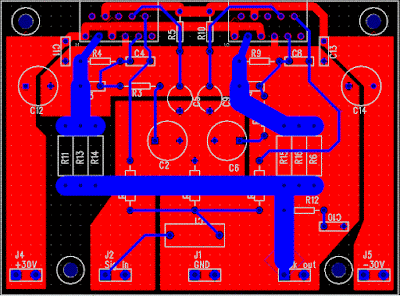 |
| Amplifier Printed Circuit Board Bottom |
 |
| Amplifier Printed Circuit Board Top |
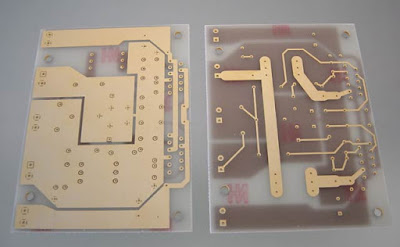 |
| Amplifier Printed Circuit Board |
The power supply used is a regulated power supply. I used 10000uF per rail before the LT1083 regulator. After the regulator, I have 100uF on the regulator board. The advantage of using regulator is that the power supply ripple voltage is removed. If power regulation is not used, I can hear very little 50/100Hz hum from the speaker.
The high current MUR860 diode is used to ensure high current flow. The voltage regulator used is LT1083, it can provide about 8A of current. Transformer used here is a 500VA 2x 25V. The power supply is then regulated by 2 LT1083, after the regulation, the voltage is 30V.
 |
| Power Supply Recomended |
The sound of this amplifier is similar to my LM3875 amplifier, which is very clean and detail. It has no hum, no hiss and no noise. Compared to the LM3875 Gainclone, this amp can deliver twice the power to my 4-ohm speaker, and it improves the dynamics and bass punch a lot.
Source :http://www.shine7.com/audio/pa100.htm

Sunday, September 22, 2013
68W Power Amplifier using LM3886
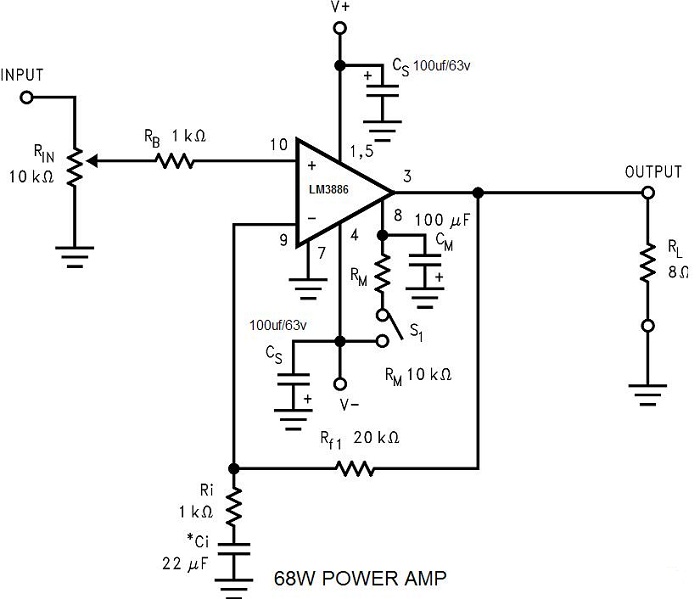 68W Power Amplifier using LM3886
features:
Maximum Output Power : 68W RMS - 108W Peak
THD : %0.03 at 60W
SNR : 110dB at 60 W - 92.5dB at 1W
PSRR : 120dB
Protection circuitries : DC /AC Short circuit protection and thermal protection
Output Class : Conjugate AB-A
The achievement of the LM3886, utilizing its Self Peak Direct Temperature (°Ke) (SPiKe™) aegis circuitry, puts it in a chic aloft detached and amalgam amplifiers by accouterment an inherently, dynamically adequate Safe Operating Area (SOA). SPiKe aegis agency that these genitalia are absolutely safeguarded at the achievement adjoin overvoltage, undervoltage, overloads, including shorts to the supplies, thermal runaway, and direct temperature peaks.
The LM3886 maintains an accomplished signal-to-noise arrangement of greater than 92dB with a archetypal low babble attic of 2.0µV. It exhibits acutely low THD+N ethics of 0.03% at the rated achievement into the rated amount over the audio spectrum, and provides accomplished breadth with an IMD (SMPTE) archetypal appraisement of 0.004%.