Friday, November 15, 2013
Transistor Checker with 555 Timer 4027IC


Monday, November 11, 2013
Transistor Water Sensor Alarm
Transistor Water Sensor Alarm Circuit Diagram

When water reaches the sensor, the base of T1 is connected to the positive supply terminal. Therefore, T1 and T2 are open, so that buzzer BZ1, will be activated. Sensitivity reduction of the circuit can be done by increasing the value of R2.
Thursday, November 7, 2013
Michas AVR Transistor tester
 |
| Michas_AVR-Transistortester |
Saturday, November 2, 2013
Single Transistor Relay Toggle
In the deactivated state, the relay contacts are arranged so the 1000 uF capacitor will charge to about 2.7 volts. When the switch is closed, the capacitor voltage is applied to the transistor base through a 560 resistor causing the transistor to turn on and activate the relay. In the activated state, the relay contacts are arranged so the 3.3K resistor and 560 ohm resistor provide a continous current to the transistor base maintaining the activated state. While in the activated state, the capacitor is allowed to discharge to zero through the 1K resistor. When the switch is again closed, the capacitor will cause the transistor base to move toward ground deactivating the relay.
Single Transistor Relay Toggle Circuit Diagram
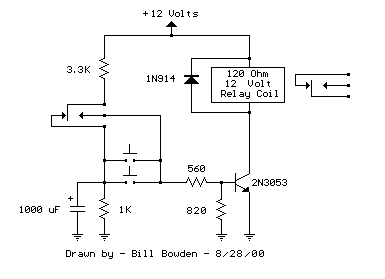
The circuit has three distinct advantages, it requires only a few parts, always comes up with the relay deactivated, and doesnt need any switch debouncing. However since the capacitor will begin charging as soon as the button is depressed, the button cannot remain depressed too long to avoid re-engaging the relay. This problem can be minimized with an additional resistor connected from the transistor base to ground so that the base voltage is close to 0.7 volts with the button depressed and the transistor is biased in the linear region. With the button held down, the relay coil voltage should be somewhere between the pull in and drop out voltages so that the relay will maintain the last toggled state.
This worked out to about 820 ohms for the circuit I built using a 12 volt, 120 ohm relay coil and 2N3053 transistor. Temperature changes will effect the situation but the operation is still greatly improved. I heated the transistor with a hair dryer and found that the relay will re-engage with the button held down for approximately 1 second, but this is not much of a problem under normal operation.
Saturday, October 12, 2013
4 Transistor 500mW FM Transmitter Circuit Diagram
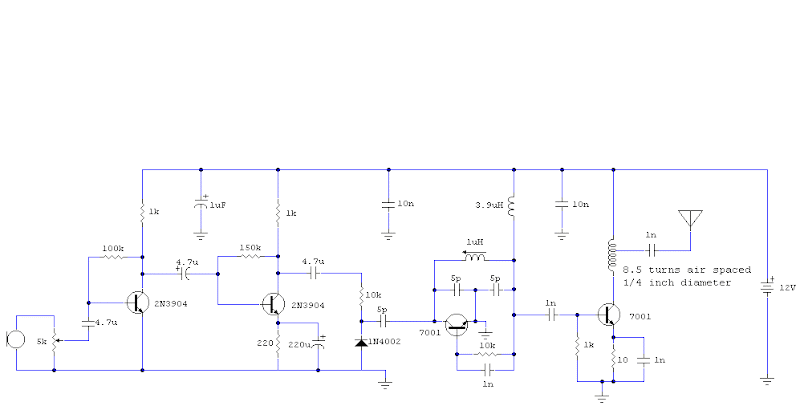 4 Transistor 500mW FM Transmitter Circuit Diagram
As shown, the audio ascribe is a microphone, which uses 2 x 2N3904 as the microphone audio preamplifier. The audio/mic ascribe akin is adjustable by agency of a 5k preset / potentiometer.
The ambit uses a Colpitts oscillator for abundance generation, which is chargeless active and operates at the axiological abundance i.e. no circuitous abundance multiplication or control. The abundance affability basic of the ambit consists of 2 5pF (picoFarad) capacitors and a distinct 10uH (micro-Henry) inductor. These apparatus can be adapted if a change in abundance is appropriate - conceivably alike replaced with capricious capacitors (if youre up to the challenge).
An achievement RF amplifier takes the abundance produced by the Colpitts oscillator and amplifier to about about the 500mW (0.5 Watt) ambit - so this is the almost achievement ability of this FM transmitter. You are brash that back this transmitter operates at the axiological frequency, and because there is no achievement filter, there is acceptable to be some abundance alluvion and harmonics/spurious emissions.