Showing posts with label diagram. Show all posts

Saturday, December 21, 2013

Multi-Tone Siren

This
multi-tone siren is useful for burglar alarms, reverse horns, etc. It
produces five different audio tones and is much more ear-catching than a
single-tone siren. The circuit is built around popular CMOS
oscillator-cum-divider IC 4060 and small audio amplifier LM386. IC 4060
is used as the mult-itone generator. A 100µH inductor is used at the
input of IC 4060. So it oscillates within the range of about 5MHz RF. IC
4060 itself divides RF signals into AF and ultrasonic ranges. Audio
signals of different frequencies are available at pins 1, 2, 3, 13 and
15 of IC 4060 (IC1).


multitone siren circuit schematic

These
multi-frequency signals are mixed and fed to the audio amplifier built
around IC LM386. The output of IC2 is fed to the speaker through
capacitor C9. If you want louder sound, use power amplifier TBA810 or
TDA1010. Only five outputs of IC1 are used here as the other five
outputs (pins 4 through 7 and 14) produce ultrasonic signals, which are
not audible. Assemble the circuit on a general-purpose PCB and enclose
in a suitable cabinet. Regulated 6V-12V (or a battery) can be used to
power the circuit.
Next full text...

Wednesday, November 13, 2013

Video Amplifier Circuit Diagram

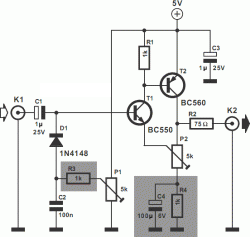
Video amplifier circuit is simple and can be used. Video amplifier circuit was constructed from 2 pieces of transistors BC550 and BC560. The source voltage used for supplying the video amplifier circuit is 5VDC. Video amplifier circuit is equipped with a powerful regulator which flows through both transistors T1 and T2, the components used to manage these flows are P1 and P2.
Video Amplifier Circuit Diagram
Video Amplifier Circuit Diagrams

Then the video amplifier circuit is also equipped with limiting the maximum current that passes through T1 and T2. The components in black block functions as limiting the maximum current that is passed by the T1 and T2 for no more than 5mA.
Next full text...

Monday, November 4, 2013

Light Switch Circuit Diagram

circuit diagram
The series of light switches this time slightly different from the voltage of work. The series of light switches can work directly on the AC power network. Light switches are using the main component of TRIAC and LDR. The circuit is very simple and the components were sold in the market.

If you want a light reception sensitivity of this circuit can be arranged then the 3.3 MOhm resistor can be replaced with a variable resistor. For more details can be seen from the following series of images.
Circuit Diagram


With Triac Light Switch series is prisipkerjanya as dimers, but dimers control performed by the reception of light around the LDR. The lower the intensity cayaha received LDR then semkin bright lights. For installation LDR need to be considered so as not exposed to light from the lamp directly.
Next full text...

Thursday, October 31, 2013

Telephone Headgear Circuit Diagram

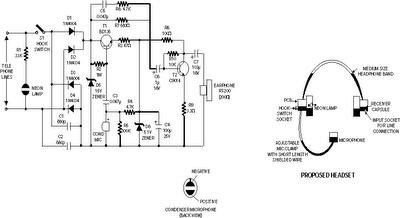
Acompact, inexpensive and low component count telecom head- set can be constructed using two readily available transistors and a few other electronic components. This circuit is very useful for hands-free operation of EPABX and pager communication. Since the circuit draws very little current, it is ideal for parallel operation with electronic telephone set. 

Telephone Headgear Circuit Diagram

Working of the circuit is simple and straightforward. Resistor R1 and an ordinary neon glow- lamp forms a complete visual ringer circuit. This simple arrangement does not require a DC blocking capacitor because, under idle conditions, the telephone line voltage is insufficient to ionise the neon gas and thus the lamp does not light. Only when the ring signal is being received, it flashes at the ringing rate to indicate an incoming call. The bridge rectifier using diodes D1 through D4 acts as a polarity guard which protects the electronic circuit from any changes in the telephone line polarity. 

Zener diode D5 at the output of this bridge rectifier is used for additional circuit protection. Section comprising transistor T1, resistors R2, R3 and zener diode D6 forms a constant voltage regulator that provides a low voltage output of about 5 volts. Dial tone and speech signals from exchange are coupled to the receiving sound amplifier stage built around transistors T2 and related parts, i.e. resistors R7, R6 and capacitor C5. Amplified signals from collector of transistor T2 are connected to dynamic receiver RT-200 (used as earpiece) via capacitor C7. A condenser microphone, connected as shown in the circuit, is used as transmitter. Audio signals developed across the microphone are coupled to the base of transistor T1 via capacitor C3. Resistor R4 determines the DC bias required for the microphone. After amplification by transistor T1, the audio signals are coupled to the telephone lines via the diode bridge. The whole circuit can be wired on a very small PCB and housed in a medium size headphone, as shown in the illustration. For better results at low line currents, value of resistor R2 may be reduced after testing
Next full text...

Tuesday, October 22, 2013

Loop Control Automatic Reversing Circuit Diagram

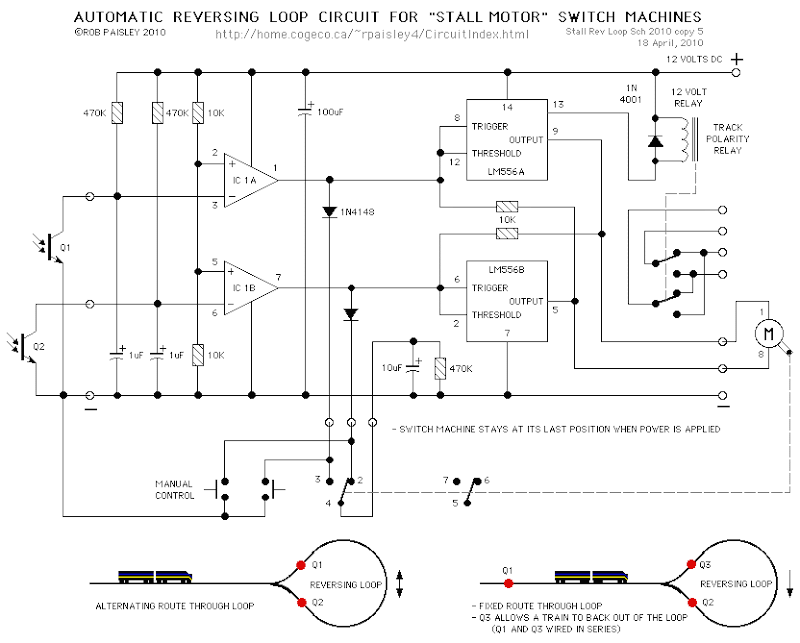
Loop Control Automatic Reversing Circuit DiagramLoop Control Automatic Reversing Circuit Diagram

It is not the purpose of this folio to accommodate a abundant account of the ICs acclimated by this circuit. If you appetite added advice on this accountable amuse accredit to the Flip-Flop Made With A LM556 Timer Chip folio in the assorted circuits area of this armpit and additionally the Visible Light Photo Detector Circuits.

*The ambit uses the basal phototransistor detector ambit to faculty the position of a alternation that is abutting or is in the abandoning loop.

*Track polarity abandoning is not covered by this folio and will accept to be bent by the user.

Please Read Afore Using These Ambit Ideas

The explanations for the circuits on these pages cannot achievement to awning every bearings on every layout. For this acumen be able to do some experimenting to get the after-effects you want. This is abnormally accurate of circuits such as the "Across Track Infrared Detection" circuits and any added ambit that relies on added than absolute cyberbanking inputs, such as switches.

If you use any of these ambit ideas, ask your genitalia supplier for a archetype of the manufacturers abstracts bedding for any apparatus that you accept not acclimated before. These bedding accommodate a abundance of abstracts and ambit architecture advice that no cyberbanking or book commodity could access and will save time and conceivably accident to the apparatus themselves. These abstracts bedding can generally be begin on the web armpit of the accessory manufacturers.

Although the circuits are anatomic the pages are not meant to be abounding descriptions of anniversary ambit but rather as guides for adapting them for use by others. If you accept any questions or comments amuse accelerate them to the email abode on the Ambit Index page.

Next full text...

Car Stereo Audio Amplifier with TDA1553CQ Circuit Diagram

Car Stereo Audio Amplifier with TDA1553CQ Circuit DiagramCar Stereo Audio Amplifier with TDA1553CQ Circuit Diagram

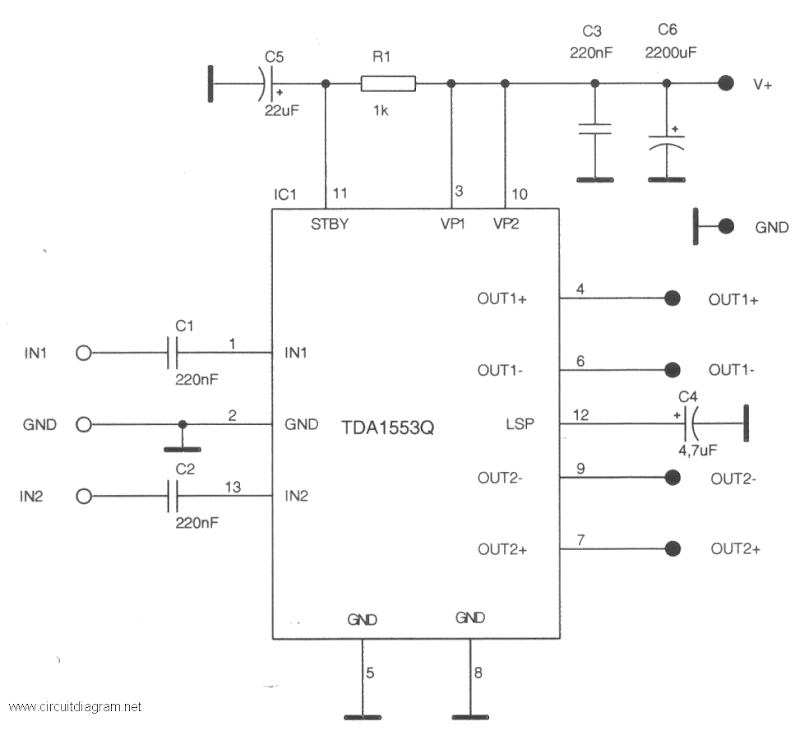
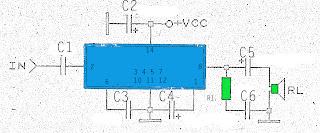
This is a stereo audio amplifier for your car. The ambit is powered by a distinct IC TDA1553 with some alien components, this IC will handle your stereo car audio system.

The TDA1553CQ is a caked chip class-B achievement amplifier in a 13-lead artificial DIL-bent-SIL ability package. It contains 2×22 W amplifiers in BTL configuration. The accessory is primarily developed for car radio applications.

Special features of the device are:

3-state mode switch

· standby: low supply current (<100>

Loudspeaker protection

When a short-circuit to ground occurs, which forces a DC voltage across the loudspeaker of >= V, a built-in protection circuit becomes active and limits the DC voltage across the loudspeaker to <= V. Pin 12 detects the status of the protection circuit (e.g. for diagnostic purposes).

Short-circuit protection

If any output is short-circuited to ground during the standby mode, it becomes impossible to switch the circuit to the mute or operating condition. In this event the supply current will be limited to a few milliamps.

Next full text...

Saturday, October 12, 2013

4 Transistor 500mW FM Transmitter Circuit Diagram

4 Transistor 500mW FM Transmitter Circuit Diagram4 Transistor 500mW FM Transmitter Circuit Diagram

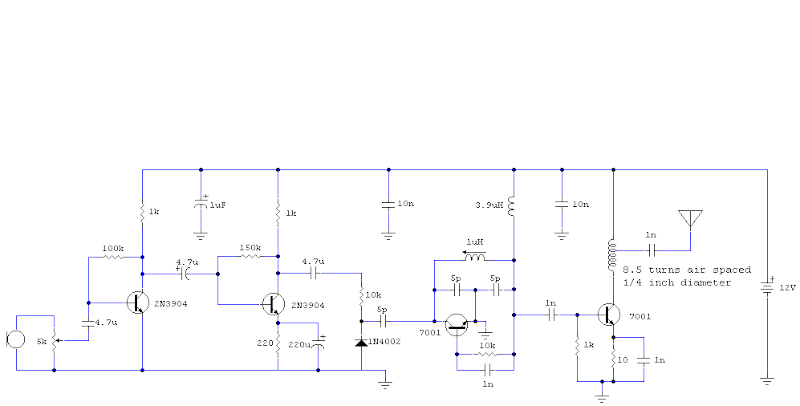
As shown, the audio ascribe is a microphone, which uses 2 x 2N3904 as the microphone audio preamplifier. The audio/mic ascribe akin is adjustable by agency of a 5k preset / potentiometer.

The ambit uses a Colpitts oscillator for abundance generation, which is chargeless active and operates at the axiological abundance i.e. no circuitous abundance multiplication or control. The abundance affability basic of the ambit consists of 2 5pF (picoFarad) capacitors and a distinct 10uH (micro-Henry) inductor. These apparatus can be adapted if a change in abundance is appropriate - conceivably alike replaced with capricious capacitors (if youre up to the challenge).

An achievement RF amplifier takes the abundance produced by the Colpitts oscillator and amplifier to about about the 500mW (0.5 Watt) ambit - so this is the almost achievement ability of this FM transmitter. You are brash that back this transmitter operates at the axiological frequency, and because there is no achievement filter, there is acceptable to be some abundance alluvion and harmonics/spurious emissions.

Next full text...

Sunday, September 29, 2013

Phone Busy Indicator Diagram

Phone Busy Indicator DiagramPhone Busy Indicator Diagram


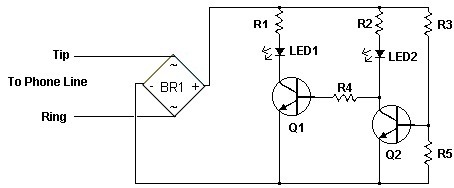
Have you anytime been application the modem or fax and addition abroad picks up the phone, breaking the connection? Well, this simple ambit should put an end to that. It signals that the buzz is in use by lighting a red LED. When the buzz is not in use, a blooming LED is lit. It needs no alien ability and can be affiliated anywhere on the buzz line, alike army central the phone.


Notes


1. This is a very simple circuit and is easily made on a perf board and mounted inside the phone.


2. LED1 and LED2 flash on and off while the phone is ringing.


3. Do not worry about mixing up the Tip and Ring connections.


4. The ring voltage on a phone line is anywhere from 90 to 130 volts. Make sure no one calls while you are making the line connections or youll know it. :-)


5. In some countries or states you will have to ask the phone company before you connect this to the line. It might even require an inspection.


6. If the circuit causes distortion on the phone line, connect a 680 ohm resistor in between one of the incoming line wires and the bridge rectifier.


Phone Busy Indicator Diagram Part List


R1 1 3.3K 1/4 W Resistor

R2 1 33K 1/4 W Resistor

R3 1 56K 1/4 W Resistor

R4 1 22K 1/4 W Resistor

R5 1 4.7K 1/4 W Resistor

Q1, Q2 2 2N3392 NPN Transistor

BR1 1 1.5 Amp 250 PIV Bridge Rectifier

LED1 1 Red LED

LED2 1 Green LED

MISC 1 Wire, Case, Phone Cord

Next full text...

Wednesday, September 25, 2013

Light Switch Circuit Diagram

circuit diagram
The series of light switches this time slightly different from the voltage of work. The series of light switches can work directly on the AC power network. Light switches are using the main component of TRIAC and LDR. The circuit is very simple and the components were sold in the market.

If you want a light reception sensitivity of this circuit can be arranged then the 3.3 MOhm resistor can be replaced with a variable resistor. For more details can be seen from the following series of images.
Circuit Diagram


With Triac Light Switch series is prisipkerjanya as dimers, but dimers control performed by the reception of light around the LDR. The lower the intensity cayaha received LDR then semkin bright lights. For installation LDR need to be considered so as not exposed to light from the lamp directly.
Next full text...

Sunday, September 22, 2013

Metal Detector Schematic Circuit Diagram

Metal Detector Schematic Circuit DiagramMetal Detector Schematic Circuit Diagram

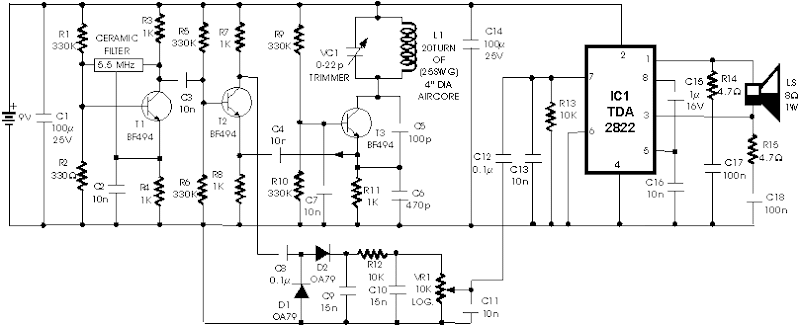
The ambit declared actuality is that of a metal detector. The opera- tion of the ambit is based on superheterodyning assumption which is frequently acclimated in superhet receivers. The ambit utilises two RF oscillators. The frequencies of both oscillators are anchored at 5.5 MHz. The aboriginal RF oscillator comprises transistor T1 (BF 494) and a 5.5MHz bowl clarify frequently acclimated in TV sound-IF section. The additional oscillator is a Colpitt�s oscillator realised with the advice of transistor T3 (BF494) and inductor L1 (whose architecture capacity follow) shunted by trimmer capacitor VC1. These two oscillators� frequencies (say Fx and Fy) are alloyed in the mixer transistor T2 (another BF 494) and the aberration or the exhausted abundance (Fx-Fy) achievement from beneficiary of transistor T2 is affiliated to detector date absolute diodes D1 and D2 (both OA 79).

The achievement is a pulsating DC which is anesthetized through a low-pass clarify realised with the advice of a 10k resistor R12 and two 15nF capacitors C6 and C10. It is again anesthetized to AF amplifier IC1 (2822M) via aggregate ascendancy VR1 and the achievement is fed to an 8-ohm/1W speaker. The inductor L1 can be complete application 15 turns of 25SWG wire on a 10cm (4-inch) bore air-core above and again cementing it with careful varnish. For able operation of the ambit it is analytical that frequencies of both the oscillators are the aforementioned so as to access aught exhausted in the absence of any metal in the abreast around of the circuit.

The alignment of oscillator 2 (to bout oscillator 1 frequency) can be done with the advice of trimmer capacitor VC1. When the two frequencies are equal, the exhausted abundance is zero, i.e. exhausted frquency=Fx-Fy=0, and appropriately there is no complete from the loudspeaker. When chase braid L1 passes over metal, the metal changes its inductance, thereby alteration the additional oscillator�s frequency. So now Fx-Fy is not aught and the loudspeaker sounds. Appropriately one is able to ascertain attendance of metal
Next full text...

Saturday, September 21, 2013

2 5 Watt audio amplifier circuit diagram

2,5W amplifier
The above is a simple amplifier circuit also has a minimal power output. By using only a few components and a single IC as the basis for the strengthening of the amplifier, this circuit has a power output of not more than 2.5 W and impedance or RL 8. Requires a minimum voltage of this amplifier is around 6V and 26V maximum voltage, the voltage must be DC or already rectified and filtered.
Part List :
R1 = 1R
C1 = 0.1uF
C2 = 100uF
C3 = 0.1uF
C4 = 5uF
C5 = 500uF
C6 = 0.1uF
IC = ULN2280B , ULN2281B , ULN3784B.
Next full text...

Monday, September 16, 2013

Opamp VHF FM Transmitter

ICs
that in the past were far too expensive for the hobbyist tend to be
more favourably priced these days. An example of this is the AD8099 from
Analog Devices. This opamp is available for only a few pounds. The
AD8099 is a very fast opamp (1600 V/ms) and has high-impedance inputs
with low input capacitance. The bandwidth of the opamp is so large that
at 100 MHz it still has a gain of nearly 40. This means that this opamp
can be used to create an RC oscillator. The circuit presented here
realises that.

The circuit has a few striking characteristics.
Firstly, unlike normal oscillators that contain transistors this one
does not have any inductors. Secondly, there is no need for a varicap
diode to do the FM modulation. The opamp is configured as a Schmitt
trigger with only a small amount of hysteresis. The output is fed back
via an RC circuit. In this way, the trimmer capacitor is continually
being charged and discharged when the voltage reaches the hysteresis
threshold. The output continually toggles as a consequence.

This
results in a square wave output voltage. With a 10-pF trimmer capacitor
the frequency can be adjusted into the VHF FM broadcast band 88-108
MHz). The frequency of the oscillator is stable enough for this. The
output voltage is about 6 Vpp at a power supply voltage of 9 V. The
transmitter power amounts to about 50 mW at a load of 50R. This is about
20 times as much as the average oscillator with a transistor. With a
short antenna of about 10 cm, the range is more than sufficient to use
the circuit in the home as a test transmitter.


 circuit schematic

Because
the output signal is not free from harmonics the use of an outdoor
antenna is not recommended. This requires an additional filter/adapter
at the output (you could use a pi-filter for this). The FM modulation is
achieved by modulating the hysteresis, which influences the oscillator
frequency. An audio signal of about 20 mVpp is sufficient for a
reasonable output amplitude. The package for the opamp is an 8-pin SOIC
(provided you use the version with he RD8 suffix). The distance between
the pins on this package is 1/20 inch 1.27 mm).

This is still
quite easy to solder with descent tools. If SMD parts are used for the
other components as well then the circuit can be made very small. If
necessary, a single transistor can be added to the circuit to act as
microphone amplifier. The power supply voltage may not be higher than 12
V, because the IC cannot withstand that. The current consumption at 9 V
is only 15 mA. As with all free-running oscillator circuits, the
output frequency of this specimen is also sensitive to variations of
the power supply voltage.

For optimum stability, a power supply
voltage regulator is essential. As an additional design tip for this
circuit, we show an application as VCO for, for example, a PLL circuit.
When the trimmer capacitor is replaced with a varicap diode, the
frequency range can be greater than that of an LC oscillator. That’s
because with an LC-oscillator the range is proportional to the square
root of the capacitance ratio. With an RC oscillator the range is equal
to the entire capacitance ratio. For example: with a capacitance ratio
of 1:9, an LC oscillator can be tuned over a range of 1:3.

With
an RC oscillator this is 1:9. For the second tip, we note that the
circuit can provide sufficient power to drive a diode mixer (such as a
SBL-1) directly. This type of mixer requires a local oscillator signal
with a power from 5 to 10 mW and as already noted, this oscillator can
deliver 50 mW. A simple attenuator with a couple of resistors is
sufficient in this case to adapt the two to each other.
Next full text...

Wednesday, September 11, 2013

Power MOSFET Bridge Rectifier

The
losses in a bridge rectifier can easily become significant when low
voltages are being rectified. The voltage drop across the bridge is a
good 1.5 V, which is a hefty 25% with an input voltage of 6V. The loss
can be reduced by around 50% by using Schottky diodes, but it would
naturally be even nicer to reduce it to practically zero. That’s
possible with a synchronous rectifier. What that means is using an
active switching system instead of a ‘passive’ bridge rectifier.

The
principle is simple: whenever the instantaneous value of the input AC
voltage is greater than the rectified output voltage, a MOSFET is
switched on to allow current to flow from the input to the output. As we
want to have a full-wave rectifier, we need four FETs instead of four
diodes, just as in a bridge rectifier. R1–R4 form a voltage divider for
the rectified voltage, and R5–R8 do the same for the AC input voltage.
As soon as the input voltage is a bit higher than the rectified
voltage, IC1d switches on MOSFET T3.

Just as in a normal bridge
rectifier, the MOSFET diagonally opposite T3 must also be switched on
at the same time. That’s taken care of by IC1b. The polarity of the AC
voltage is reversed during the next half-wave, so IC1c and IC1a switch
on T4 and T1, respectively. As you can see, the voltage dividers are
not fully symmetrical. The input voltage is reduced slightly to cause a
slight delay in switching on the FETs. That is better than switching
them on too soon, which would increase the losses.


Power MOSFET Bridge Rectifier circuit schematic

Be
sure to use 1% resistors for the dividers, or (if you can get them)
even 0.1% resistors. The control circuit around the TL084 is powered
from the rectified voltage, so an auxiliary supply is not necessary.
Naturally, that raises the question of how that can work. At the
beginning, there won’t be any voltage, so the rectifier won’t work and
there never will be any voltage... Fortunately, we have a bit of luck
here. Due to their internal structures, all FETs have internal diodes,
which are shown in dashed outline here for clarity.

They allow
the circuit to start up (with losses). There’s not much that has to be
said about the choice of FETs – it’s not critical. You can use whatever
you can put your hands on, but bear in mind that the loss depends on
the internal resistance. Nowadays, a value of 20 to 50 mW is quite
common. Such FETs can handle currents on the order of 50 A. That sounds
like a lot, but an average current of 5 A can easily result in peak
currents of 50 A in the FETs.

The IRFZ48N (55 V @ 64 A, 16 mW)
specified by the author is no longer made, but you might still be able
to buy it, or you can use a different type. For instance, the IRF4905
can handle 55 V @ 74 A and has an internal resistance of 20 mR. At
voltages above 6 V, it is recommended to increase the value of the
8.2-kR resistors, for example to 15 kR for 9V or 22 kR for 12 V.
Next full text...